
Sprite-Marinated Inihaw na Liempo: Filipino BBQ Pork Belly
 Recipe Guy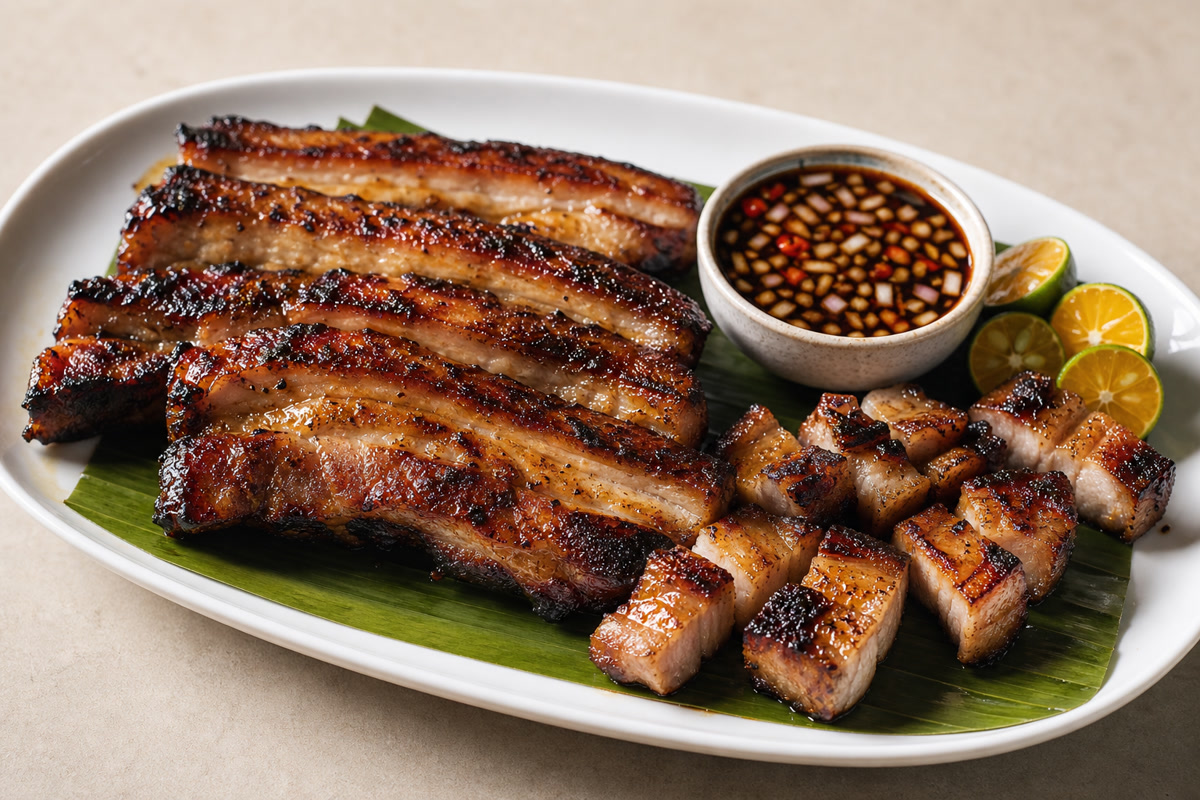
Inihaw na liempo sa soda | Calamansi-soy marinade | Banana ketchup glaze
Sprite-marinated inihaw na liempo is savory, citrusy, and glossy with banana ketchup, then grilled over two heat zones for rendered edges without a scorched glaze.
About This Recipe
Inihaw na liempo means grilled pork belly: inihaw comes from ihaw, to grill, and liempo is the belly cut. There is no single household formula. Soy sauce, calamansi, garlic, pepper, and a little sweetness are common, while banana ketchup and lemon-lime soda appear in many home and barbecue-stand versions. This U.S.-kitchen recipe uses boneless, skinless belly; a refrigerator marinade; a two-zone gas or charcoal fire; and a separately mixed, cooked glaze that never contacts raw pork. The result is smoky and savory first, with a shiny sweet-tangy finish and a sharp vinegar sawsawan to cut the richness.
Ingredient Notes
Pork belly
Choose boneless, skinless belly with alternating bands of meat and fat. Ask the butcher to slice it lengthwise 3/8 to 1/2 inch thick, or chill a slab for 30 minutes before slicing. Skin can stay chewy during this relatively quick cook.
Calamansi
Frozen or bottled 100 percent calamansi juice works well. Avoid a sweetened calamansi beverage. For each 1/4 cup calamansi juice, substitute 2 tablespoons fresh lemon juice plus 2 tablespoons fresh lime juice.
Banana ketchup
Banana ketchup supplies the familiar red color, fruitiness, vinegar, and sugar of Filipino barbecue. Tomato ketchup works in the same quantity, but the finished glaze will taste tangier and less fruity.
Soy sauce
Reduced-sodium soy sauce keeps the long marinade from becoming harsh. If using a saltier Filipino soy sauce, replace the 1/3 cup in the marinade with 1/4 cup soy sauce plus 1 tablespoon water.
Lemon-lime soda
A small amount rounds the citrus and echoes a popular home-style barbecue variation without making the pork taste like soda. Do not increase it; too much sugar makes the surface scorch before the belly renders.
Clean basting glaze
The glaze is a fresh, separately measured batch, not leftover raw-pork marinade. It is simmered to dissolve the sugar, then divided into a brush bowl and a clean finishing bowl so table sauce never meets the grill brush.
Sawsawan
Cane vinegar, calamansi, onion, and chile make a sharp dipping sauce that balances fatty liempo. Let it stand at least 15 minutes, then offer it at the table rather than pouring it over every serving.
Sprite-Marinated Inihaw na Liempo: Filipino BBQ Pork Belly Recipe
Sprite-marinated inihaw na liempo is savory, citrusy, and glossy with banana ketchup, then grilled over two heat zones for rendered edges without a scorched glaze.
Yield: 6 servings Serving size: About 3 1/2 ounces cooked pork belly plus 1 tablespoon sawsawan; rice and vegetables are not included.
Yield note: Two pounds of raw pork belly should yield about 20 to 22 ounces after grilling and rendering, enough for six rich ulam portions of roughly 3 to 4 ounces each. Belly thickness and fat-to-meat ratio cause meaningful variation, so portion the finished meat by weight when nutrition precision matters.
Shopping List
- 2 pounds boneless skinless pork belly, sliced 3/8 to 1/2 inch thick
- reduced-sodium soy sauce
- 100 percent calamansi juice, or fresh lemons and limes
- banana ketchup
- lemon-lime soda
- garlic
- oyster sauce
- dark brown sugar
- black pepper
- cane vinegar or unseasoned rice vinegar
- red onion
- 1 Thai chile or serrano chile, optional
- high-heat neutral oil
- white rice, cucumber, tomatoes, and citrus wedges, optional
Ingredients
Pork and Refrigerator Marinade
- 2 pounds boneless skinless pork belly, sliced lengthwise 3/8 to 1/2 inch thick
- 1/3 cup reduced-sodium soy sauce
- 1/4 cup 100 percent calamansi juice, or 2 tablespoons lemon juice plus 2 tablespoons lime juice
- 1/4 cup banana ketchup
- 1/4 cup lemon-lime soda, such as Sprite or 7UP
- 6 large garlic cloves, finely grated or minced
- 1 tablespoon oyster sauce
- 1 tablespoon packed dark brown sugar
- 1 teaspoon freshly ground black pepper
Fresh Cooked Basting Glaze (No Raw-Pork Contact)
- 1/4 cup banana ketchup
- 2 tablespoons reduced-sodium soy sauce
- 2 tablespoons water
- 1 tablespoon 100 percent calamansi juice, or 1 1/2 teaspoons lemon juice plus 1 1/2 teaspoons lime juice
- 1 tablespoon packed dark brown sugar
- 1 teaspoon oyster sauce
- 1 large garlic clove, finely grated
Spiced Vinegar Sawsawan
- 1/3 cup cane vinegar or unseasoned rice vinegar
- 2 tablespoons 100 percent calamansi juice, or 1 tablespoon lemon juice plus 1 tablespoon lime juice
- 1 tablespoon reduced-sodium soy sauce
- 1/4 cup finely chopped red onion
- 1 Thai chile or serrano chile, thinly sliced, optional
- 1/4 teaspoon freshly ground black pepper
For the Grill and Serving
- 2 teaspoons high-heat neutral oil, such as avocado or canola oil, for the grates
- 6 cups hot cooked white rice, optional
- 1 medium cucumber, thinly sliced, optional
- 2 medium tomatoes, cut into wedges, optional
- 6 calamansi or lemon wedges, optional
Instructions
- Inspect the pork belly and trim only thin flaps or heavy knobs of exterior fat that are likely to drip and burn. Do not rinse the raw pork. If the pieces are wider than about 2 inches, cut them lengthwise into manageable strips while leaving their full length intact.
- Whisk the reduced-sodium soy sauce, calamansi juice, banana ketchup, lemon-lime soda, garlic, oyster sauce, brown sugar, and black pepper in a nonreactive glass or food-grade plastic container until the sugar dissolves.
- Add the pork and turn every strip until coated. Cover and marinate in a refrigerator at 40 degrees F or below for at least 4 hours and no longer than 12 hours for the best salt and citrus balance. Turn the container once halfway through if the liquid does not cover the pork.
- Make the sawsawan at least 15 minutes before serving. Stir together the vinegar, calamansi juice, soy sauce, red onion, optional chile, and black pepper. Cover and refrigerate until needed; stir again before pouring it into individual dipping bowls.
- Make the glaze from its own fresh ingredients: combine banana ketchup, soy sauce, water, calamansi juice, brown sugar, oyster sauce, and garlic in a small saucepan. Bring to a full simmer over medium heat, then cook 3 to 4 minutes, stirring often, until the sugar dissolves and the glaze lightly coats a spoon.
- Pour about 1/3 cup cooked glaze into a small bowl for brushing at the grill. Pour the remainder into a separate clean bowl for finishing the cooked pork. Cover both bowls. The finishing portion and its utensil must stay away from raw pork, the raw-meat tray, and the grill brush.
- Set up a two-zone grill. For gas, heat one side to medium and leave the other side on low or off. For charcoal, bank the lit coals on one half. Preheat to about 375 to 425 degrees F at grate level, scrub the grates clean, then oil them lightly with the neutral oil held in a folded paper towel with long tongs.
- Take the pork directly from the refrigerator when the grill is ready. Lift each strip from the marinade, let it drain, and scrape off clumps of garlic that could burn. Blot only puddled marinade from the surface with paper towels. Discard all marinade that touched the raw pork and wash the container and raw-meat tongs before reusing them.
- Lay the strips across the direct-heat side without crowding. Grill uncovered for 2 to 3 minutes, until the meat releases from the grate and the first side is browned. Turn with clean long-handled tongs and brown the second side for 2 to 3 minutes.
- Continue grilling, turning every 2 to 3 minutes so the fat renders evenly. Move pieces to the cooler side whenever dripping fat causes sustained flames; close the lid briefly or reduce the burner instead of spraying water onto the fire. Rotate the strips because grill hot spots can brown the sugary marinade at different rates.
- After 10 to 14 minutes total, check the thickest, meatiest strip. Insert an instant-read thermometer sideways into a meat band, avoiding the fat layers. When the pork is well browned and nearing 135 to 140 degrees F, move all strips to the cooler side for glazing.
- Brush a thin layer of the grill-bowl glaze over both sides. Cook over indirect or low heat for 1 to 2 minutes per side, turning and brushing once more, until the glaze looks shiny, bubbles at the edges, and develops dark mahogany patches without turning black. Discard any glaze left in the brush bowl.
- Check several pieces with the thermometer. Every strip must reach at least 145 degrees F in its thickest meat band, followed by a minimum 3-minute rest. For a firmer, more rendered liempo texture, continue to about 155 to 160 degrees F while watching the glaze closely; temperature, not color, is the doneness test.
- Transfer the pork with clean tongs to a clean platter that never held raw meat. Rest 5 minutes. During the rest, brush only with the reserved clean finishing glaze, using a clean spoon or brush.
- Cut the strips crosswise into 1 1/2-inch pieces, or serve them whole. Spoon the sawsawan into individual bowls and serve the pork hot with optional rice, cucumber, tomatoes, and citrus wedges.
Nutrition Estimate
Nutrition is an estimate, not a laboratory analysis or medical recommendation. Pork belly composition, trimming, rendered-fat loss, condiment brands, marinade pickup, glaze use, and portion weight can change the values substantially. People following a medically prescribed diet should calculate with the exact products and cooked weights they use.
Tips For The Best Sprite-Marinated Inihaw na Liempo: Filipino BBQ Pork Belly
- Marinate cold: Keep pork covered in the refrigerator at 40 degrees F or below for the full 4 to 12 hours. Never marinate it on the counter.
- Discard the raw marinade: Do not brush the pork with liquid that held raw meat. USDA guidance requires used marinade to be boiled before use; this recipe takes the clearer route of making a separate cooked glaze.
- Separate raw and cooked tools: Use a clean platter and clean tongs for finished pork. Wash hands, the raw-pork container, and utensils with hot soapy water before they touch cooked food.
- Measure doneness: Whole-muscle pork must reach at least 145 degrees F and rest at least 3 minutes. Slide the thermometer through a meaty band from the side so the sensing area is not sitting in fat or touching the grate.
- Control flare-ups: Pork belly releases enough fat to ignite. Keep a cooler zone available, use long tongs, and move the meat when flames persist. Never lean over the fire or spray water onto a grease flare-up.
- Chill leftovers promptly: Refrigerate cooked pork and sawsawan within 2 hours, or within 1 hour when the outdoor temperature is above 90 degrees F. Use shallow containers so the food cools quickly.
How To Serve And Store
Serving: Serve liempo as ulam with hot white rice, individual bowls of sawsawan, and something crisp or pickled, such as cucumber, tomato, atchara, or ensaladang talong. A 3 to 4 ounce cooked portion is rich; let rice and vegetables complete the plate.
Make Ahead: The pork can marinate for up to 12 hours. The cooked glaze can be cooled and refrigerated in a covered container for up to 3 days; rewarm it before dividing. The sawsawan can be refrigerated for up to 2 days, though the onion is crispest the first day.
Refrigerate: Place leftovers in shallow airtight containers within 2 hours of cooking, or within 1 hour above 90 degrees F. Refrigerate at 40 degrees F or below and eat within 3 to 4 days. Store sawsawan separately.
Freeze: Freeze cooked pork in meal-size portions for up to 2 months for best glaze and texture. Thaw overnight in the refrigerator.
Reheat: Reheat on a rack in a 375 degrees F oven or air fryer until the edges sizzle and the center reaches 165 degrees F. A covered skillet over medium-low heat also works; add 1 teaspoon water, then uncover briefly to reset the glaze.
Common Questions
What can I use instead of calamansi?
Use equal parts fresh lemon and lime juice. The blend is closer to calamansi than either fruit alone. Avoid sweetened bottled lemonade or calamansi drink because it changes both the acidity and sugar level.
Can I use tomato ketchup instead of banana ketchup?
Yes. Replace it one-for-one in both the marinade and glaze. The color will be similar, but the flavor will be sharper and less fruity; taste the cooked glaze before adding any extra sugar.
Can I marinate the pork overnight?
Yes. Eight to 12 hours in the refrigerator is ideal for this formula. Beyond 12 hours the thin pieces can become too salty and the exterior texture can turn slightly cured, so cook the pork the next day rather than extending the marinade.
Can I baste with the marinade that held the raw pork?
Not as-is. It can carry raw-pork bacteria. USDA says a used marinade must be boiled before brushing onto cooked pork. This recipe intentionally uses a separately measured, cooked glaze, which is easier to manage safely and gives more predictable sweetness.
How do I know when thin pork belly is done?
Do not rely on a dark glaze or clear juices. Fold the thickest strip slightly and insert an instant-read thermometer from the side into a meat band. It needs to reach at least 145 degrees F and rest 3 minutes; 155 to 160 degrees F gives belly a more rendered, firmer bite.
How can I cook this without an outdoor grill?
Set a wire rack over a foil-lined rimmed sheet pan. Roast at 425 degrees F for 14 to 18 minutes, turning halfway, until the pork is near its target temperature. Brush with glaze and broil 5 to 6 inches from the element for 1 to 2 minutes per side. Ventilate well, watch constantly, verify at least 145 degrees F, and rest 3 minutes.
Why did my glaze burn before the pork was ready?
The fire was too hot or the glaze went on too early. Cook the belly mostly unglazed over medium heat, keep a cooler zone available, scrape off loose garlic, and apply thin coats only for the final few minutes. Black, bitter patches are scorched sugar, not desirable caramelization.
Can I make this with pork shoulder?
Yes. Slice boneless shoulder across the grain into 1/4- to 3/8-inch steaks and use the same marinade and glaze. The result will be leaner and closer to Filipino pork barbecue than classic liempo, and it should still reach 145 degrees F with a 3-minute rest.