Mochi Balls Six Ways
 Recipe Guy
Desserts | Fil-Am Fusion | Party and Potluck
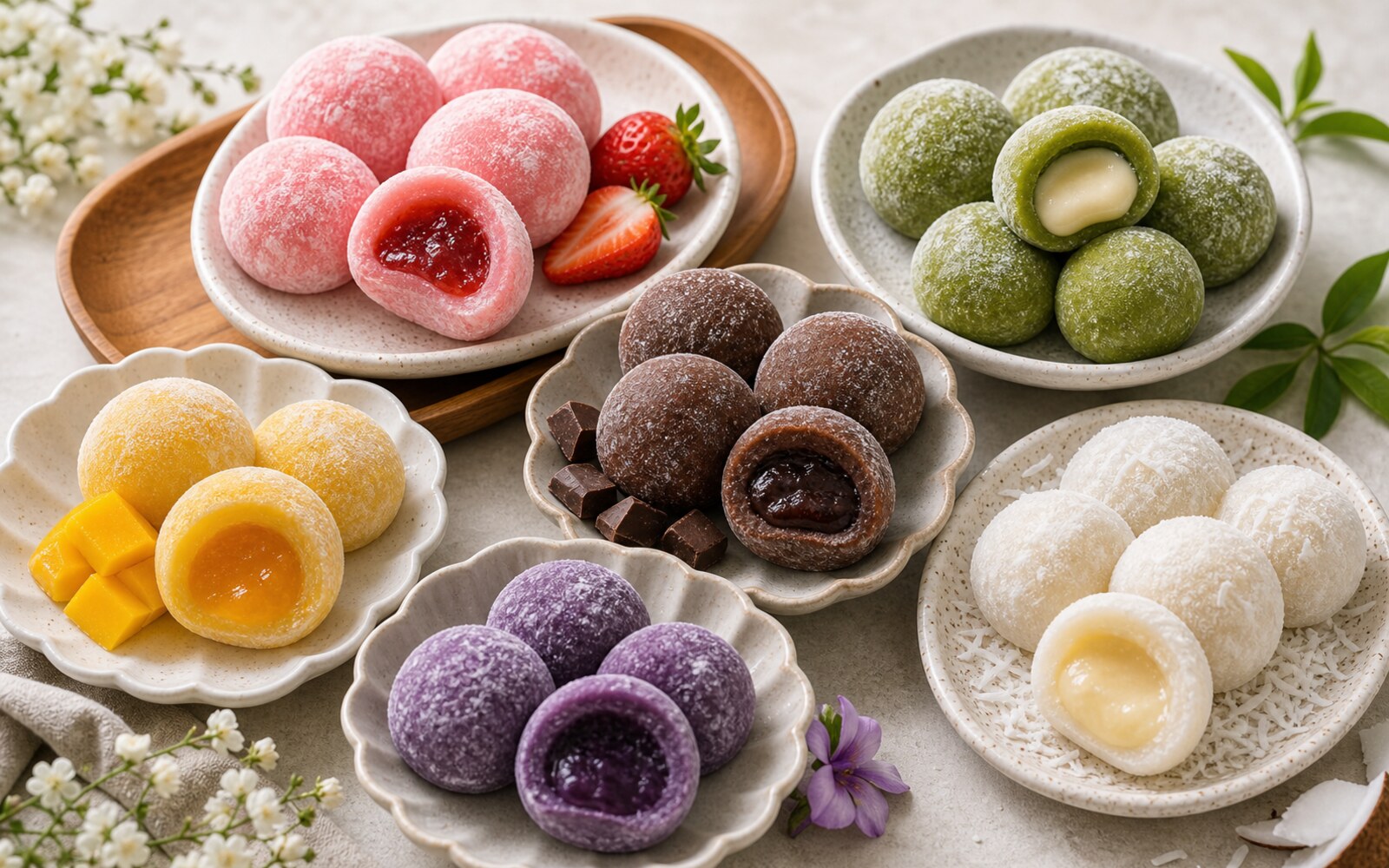
Strawberry, matcha, chocolate, mango, ube, and coconut each bring something different to mochi. This guide links complete author recipes for five flavors and supplies a measured coconut-condensed-milk version below. Each has its own dough and filling balance; the flavors are not interchangeable additions to one batch.
About This Guide
For filled mochi, choose a complete dough-and-filling recipe before buying ingredients. Flour type, liquid, sugar, filling weight, equipment, and cooking method belong to that formula. Keep portions covered as you shape, and handle cooked dough only after it is comfortable to touch.
Wet mango puree and ube halaya change hydration and sweetness; matcha and cocoa change the dry ingredients. Use the chosen recipe as a complete formula instead of stirring flavorings into a different dough by eye. The coconut version below has its own measured filling and twelve-piece yield.
Cooking Notes
- Portion the filling before flattening the dough rounds so the dough spends less time exposed. Keep the portions small enough to leave a clean border for pinching closed.
- Use the dusting ingredient specified by your chosen recipe, checking its label for the intended uncooked use. Do not substitute raw rice flour; home toasting is not a reliable way to make flour safe to eat. Keep excess powder off the sealing edges.
Ingredient Notes
Flour
Use the specific glutinous rice flour named in the selected recipe. Shiratamako and mochiko have different weights and handling; regular rice flour is not a substitute. Measure any permitted alternative as that author directs.
Filling
Follow the selected filling weight and portion count. Jam, white chocolate, chocolate spread, and halaya are not direct replacements for a measured bean-paste or ganache filling.
Mochi Balls Six Ways Guide
Choose one of the five complete author recipes or the coconut recipe below. There is no combined shopping quantity, cooking time, or yield for all six.
Shopping By Recipe
For each linked recipe, buy its specified flour type, liquid, sugar, and measured filling ingredients. For coconut, use the full list below. If flour is used uncooked as dusting, it must be commercially treated and explicitly labeled ready-to-eat; do not rely on home toasting or heat treatment. The coconut recipe uses ready-to-eat shredded coconut for handling and coating instead.
Six Complete Recipe Choices
- Strawberry: Namiko Hirasawa Chen's strawberry daifuku wraps whole strawberries with sweet bean paste and mochi. Follow her fruit sizing and measured six-piece batch, not a jam or strawberry-powder substitution.
- Matcha: Her green tea mochi gives separate measured versions with matcha in the wrapper or white bean filling. White chocolate is a different filling, not an equal-volume substitute.
- Chocolate: Marc Matsumoto's chocolate mochi pairs cocoa dough with a measured ganache filling. Allow for chilling the ganache and use that recipe's microwave power and sequence.
- Mango: Joanna Chung's mango mochi at the National Mango Board supplies a complete coconut-milk dough and fresh-fruit filling method. Use commercially treated, ready-to-eat rice flour for its dusting step instead of the recipe's home-toasted flour; home toasting is not a validated safety treatment. Mango goes inside the wrapper, not into the dough as unmeasured puree.
- Ube: Kiya's ube mochi with ube halaya filling measures halaya separately in the batter and center. Choose ready-to-eat halaya, use commercially treated ready-to-eat flour rather than raw mochiko for dusting, and refrigerate the finished mochi under the storage guidance below.
- Coconut-condensed milk: Make the complete twelve-piece recipe below. Its plain wrapper surrounds a measured coconut filling; it is not a condensed-milk substitution in any of the other doughs.
Coconut-Condensed-Milk Mochi: 12 Pieces
The wrapper is adapted from Namiko Hirasawa Chen's daifuku method; the filling uses the coconut-to-milk balance in Julia Pinney's condensed-milk coconut balls. This combination has not been kitchen-tested here.
Ingredients And Equipment
- 100 g shiratamako glutinous rice flour (about 3/4 cup; use this flour for this formula)
- 1/4 cup (50 g) granulated sugar
- 3/4 cup (180 ml) water
- 1 cup finely shredded unsweetened ready-to-eat coconut, divided: 3/4 cup for filling and 1/4 cup for shaping and coating
- 1/4 cup sweetened condensed milk
- 1-quart microwave-safe bowl about 6 inches across, a vented microwave-safe cover, silicone spatula, and an 1100-watt microwave
Method
- Combine 3/4 cup coconut with the condensed milk. Refrigerate 30 minutes so the coconut absorbs moisture, then divide evenly into 12 small filling portions. Keep chilled while making the wrapper.
- Whisk the flour and sugar in the microwave-safe bowl. Gradually stir in the water until no dry pockets remain. Cover loosely with the vented cover.
- Microwave at full power, 1100 watts, for 1 minute. Using oven mitts, uncover away from your face and stir thoroughly with a damp silicone spatula, scraping the sides into the center. Cover and heat 1 minute more, then stir again. Cover and heat another 30 seconds. The dough should be cohesive, stretchy, and translucent throughout, with no opaque floury patches; if needed, stir and heat in additional 15-second intervals. This roughly 2 1/2-3 minute sequence is for this batch and power only, not a doubled batch or another flavored dough.
- Let the dough cool just until it is safe to handle. Scatter some of the remaining 1/4 cup coconut on a silicone mat. With lightly damp hands or food-safe gloves, divide dough into 12 equal portions and keep them loosely covered. Flatten each to a roughly 3-inch circle, leaving the sealing edge free of coconut.
- Place one filling portion in the center, draw the wrapper around it, and pinch firmly closed. Set seam-side down and coat with the remaining coconut. Serve promptly, or refrigerate covered as directed below. Allow about 35-45 minutes including the filling chill and shaping; the microwave time is additional.
Cooking Other Flavors
Use the complete linked recipe's batch and equipment. Strawberry uses an 1100-watt microwave with stirring between two 1-minute intervals and a final 30 seconds, or a separate 10-12-minute steaming method with stirring. Those timings do not apply to a larger milk-based batch. Chocolate uses a different power and sequence. Do not transfer times between recipes or replace steaming with an assumed equal microwave duration.
Nutrition By Selected Recipe
This is a collection of alternatives, not one combined recipe. A single calorie or nutrient total would be misleading. Use the ingredient quantities, yield and nutrition estimate for the individual recipe you choose; its estimate does not include every variation, optional topping, sauce or side dish. The separate formulas above require separate calculations for their stated portions; no combined estimate is provided.
Tips For The Best Mochi Balls Six Ways
- Work while warm: Warm mochi stretches more easily.
- Dust lightly: Too much starch dulls the flavor.
- Serve fresh: Mochi firms in the refrigerator.
- Keep covered: The dough dries quickly.
How To Serve And Store
Serve freshly prepared mochi the same day for its best texture. Keep fruit-, dairy-, and halaya-containing portions covered in the refrigerator at 40 F or below; do not leave them out longer than 2 hours, or 1 hour above 90 F. Use the coconut version within 2 days. Follow a shorter storage limit on the selected recipe or purchased product. Refrigeration can firm the dough; that is not a reason to keep perishable fillings warm.
Common Questions
Can I make this ahead?
Follow the chosen recipe's preparation order, including chilling ganache or the coconut filling before shaping. Freshly assembled mochi has the softest texture; refrigerate perishable fillings and finished portions.
Can I refrigerate it?
Yes. Refrigerate at 40 F or below even though mochi firms when cold. Use the coconut version within 2 days. Take out only the portion being served and observe the 2-hour room-temperature limit, reduced to 1 hour above 90 F.
Can I use coconut milk?
Use the linked mango or ube recipe, which already accounts for coconut milk. Do not swap it into the water-based coconut-condensed-milk wrapper below by eye.
Can I skip filling?
You may leave the coconut recipe's twelve wrappers unfilled and coat with its measured finishing coconut; omit the filling's 3/4 cup coconut and 1/4 cup condensed milk. That produces a different, lighter portion and needs separate nutrition calculation.
Can I use regular rice flour for the mochi dough?
No. Use the specified glutinous rice flour. The onsite coconut formula uses shiratamako; other linked recipes supply their own flour choices and weights.
Why does my mochi open at the seam after filling?
Check the filling portion and wrapper size. Too much filling or coating at the border prevents a firm seal; keep unused dough covered so it remains pliable.

Technique and food-safety references: justonecookbook.com; justonecookbook.com; norecipes.com; fda.gov; fsis.usda.gov; mango.org; kiyafries.com; justonecookbook.com; juliascuisine.com.