
Crispy Pata: Filipino Fried Pork Leg with Vinegar Dip
 Recipe Guy

Filipino party platter | Crispy pork leg | Vinegar dip
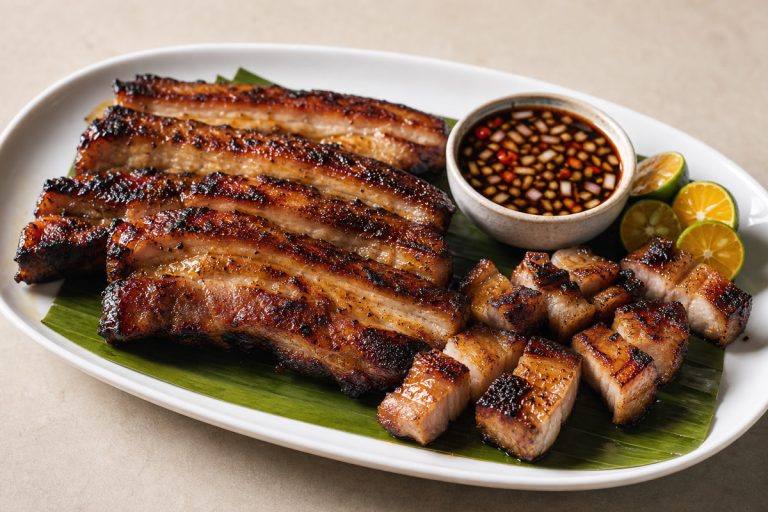
Crispy pata is a project in two textures: pork simmered until tender, then skin dried and fried until blistered. Garlic, bay leaves, and peppercorns season the first stage. A cane-vinegar dip with onion and chiles cuts through the rich finished meat.
Before cooking: This same-day version keeps the whole pork leg: simmer it fully, drain and dry the surface promptly, then fry only in equipment whose documented food-load, basket, lift and oil-fill limits accommodate the intact cut. Do not attempt the fry in an improvised pot or an undersized fryer.
Fresh From the Kitchen


About This Recipe
A whole 4-pound leg is the main presentation; two large hocks totaling 4 pounds remain an alternative. The simmer should soften the meat without making it collapse. Before starting, confirm that the intact cut fits a purpose-built fryer basket and its documented food-load and lifting limits; a roomy simmering pot is not a frying setup.
This method moves from a full simmer to prompt surface drying and frying on the same day. It does not chill or freeze the cooked whole leg. After frying, drain on a rack and rest 10 minutes before chopping; keep the vinegar dip separate so the skin stays crisp.
Cooking Notes
- Drain on a rack and blot the skin folds and cut surfaces until no water beads or drips remain. Fry promptly after drying; the meat need not become cold. Keep the fryer, basket and utensils completely dry, and never fry an icy or wet leg.
- Check the empty, cold fryer and basket before cooking. The entire leg must fit below the basket's food-fill limit with circulation space and a manufacturer-approved lift that supports its weight. Do not use tongs alone to suspend the leg over oil.
Ingredient Notes
For the pork
Use a fresh, skin-on whole pork leg of about 4 pounds, completely refrigerator-thawed if previously frozen. Two large hocks totaling the same weight may be fried one at a time if they meet all the same equipment limits; neither option belongs in an improvised pot of oil.
For crisp skin
Drying the surface is essential, but this same-day method does not require overnight refrigeration. Blot thoroughly after draining and again immediately before loading the basket. Never extend counter drying beyond the time limits in the card.
Crispy Pata Recipe
This same-day version keeps the whole pork leg: simmer it fully, drain and dry the surface promptly, then fry only in equipment whose documented food-load, basket, lift and oil-fill limits accommodate the intact cut. Confirm every equipment requirement below before cooking the pork.
Shopping List
- fresh skin-on whole pork leg or large hocks, about 4 pounds total
- bay leaves
- peppercorns
- garlic
- salt
- neutral frying oil
- cane vinegar
- soy sauce
- red onion
- Thai chiles
- steamed rice
Ingredients
Pork
- 1 whole pork leg or 2 large pork hocks, about 4 pounds total
- 10 cups water
- 1 head garlic, halved
- 3 bay leaves
- 1 tablespoon salt
- 1 teaspoon whole peppercorns
Frying
- Neutral high-smoke-point oil, such as canola or peanut, in the exact quantity required by the selected fryer's fill instructions after allowing for this food's displacement; do not substitute an arbitrary number of cups
- Extra salt for the skin, added lightly after frying
Vinegar Dip and Serving
- 1/2 cup cane vinegar
- 2 tablespoons soy sauce
- 1 small red onion, minced
- 2 Thai chiles, sliced
- Steamed rice
Equipment Check Before Starting
Use a purpose-built, temperature-controlled deep fryer whose documented food-load rating is at least 4 pounds and whose basket and lifting system are rated for the intact leg's weight and dimensions. It must hold the leg fully inside the basket, below its food MAX mark, with room for oil circulation and immersion without hand-turning over hot oil. Oil capacity in pounds or liters is not a food-load rating. Follow the manufacturer's installation, ventilation, electrical and lid instructions; a fryer night cover is not necessarily a cooking lid.
Before heating, establish the oil quantity using the device's prescribed cold-fill/displacement procedure. Stay within its oil MIN/MAX marks and any loaded-fill limit. With the leg and basket displacing oil, require at least 3 inches of clear space below the vessel rim, or the manufacturer's larger clearance, to allow for expansion and bubbling. This is an additional conservative equipment-selection condition, not permission to underfill below MIN. If the device cannot satisfy all fill, load, immersion and headspace requirements, or its instructions leave these unclear, do not attempt this recipe in it. Do not improvise a stockpot fryer, lifting rig or water-displacement test in hot equipment.
Instructions
- Complete the equipment check first. Put the pork, 10 cups water, garlic, bay leaves, 1 tablespoon salt and peppercorns in a separate simmering pot large enough for the cut. Add water as needed to cover. Bring to a boil, then simmer gently, partially covered, about 1 1/2 to 2 hours or longer as needed until fully cooked and fork-tender but still intact. Do not stop at partially cooked meat.
- Support the cooked pork with a sturdy food-safe lifting basket or wide lifting utensils and transfer to a rack over a rimmed tray, away from the fryer. Let steam escape and blot all surfaces, folds and crevices repeatedly. Allow about 20 to 30 minutes for draining and surface drying; no wet patches, beads or dripping liquid may remain. Do not wait for the whole center to cool, and do not refrigerate or freeze it for this same-day method.
- Coordinate drying and fryer preheating so the pork is fried promptly. Keep the interval from leaving the simmering broth to entering the fryer under 2 hours, or under 1 hour when the room is above 90 F. Never prolong counter drying to get crisp skin. If the pork cannot be made surface-dry and fried within that window, abandon the whole-leg fry and portion and refrigerate it promptly for another meal before the limit; discard it if the time limit has already been exceeded.
- With the fryer switched off and all equipment dry, add the previously established oil quantity. Heat to 350 F, using the thermostat and an oil-rated thermometer as directed by the manufacturer. Keep the fryer attended on its prescribed stable, dry installation surface. Keep water away and have a suitable kitchen fire extinguisher available; never use water on an oil fire.
- Blot the pork again. Load it into the dry basket while the basket is out of the oil and securely supported. Use the approved basket handle or lifting system and dry heat-resistant protection to lower it slowly according to the fryer instructions, keeping face and hands away from splatter. Do not carry the leg above hot oil with ordinary tongs, crowd the basket, add liquid, or leave the fryer unattended. For two hocks, fry one at a time and restore 350 F between batches.
- Maintain about 350 F and allow roughly 15 to 20 minutes for the fully cooked, still-warm leg, beginning checks around 10 minutes. Fry until the skin is blistered, deep golden and crisp. Raise and drain the basket using its approved support; transfer the pork securely to a clean rack or tray before checking the thickest meat away from bone. It must reach at least 165 F for this finishing method. Continue frying and recheck if needed; elapsed time, reduced popping and skin color are not temperature tests. Do not manipulate or turn the heavy leg by hand over the oil.
- Drain on a rack and season the skin lightly with the listed extra salt. Rest 10 minutes before chopping around the bones. If finishing a second hock, keep the first on a rack in a 200 F oven, verifying the meat stays at least 140 F until service.
- Stir together the 1/2 cup cane vinegar, 2 tablespoons soy sauce, minced onion and sliced chiles. Serve the pork with the separate dip and steamed rice.
Nutrition Estimate
Approximate values per serving based on the listed ingredients and yield. Actual nutrition will vary by brand, exact portion size, and cooking changes. Existing rough estimate excludes absorbed frying oil; edible pork yield and fat loss during cooking have not been measured. Bones are not part of the serving weight, and actual portions may differ substantially.
Tips For The Best Crispy Pata
- Dry promptly: Blot the same-day simmered leg until its surface and skin folds are dry; do not freeze it or leave it out for hours.
- Check equipment first: Use only a rated deep fryer, basket and lift that meet every load, fill and headspace condition in the card. An improvised deep pot is not an alternative.
- Do not overboil: If the pork collapses, it is harder to fry cleanly.
- Recrisp leftovers: Use an oven or air fryer instead of the microwave.
How To Serve And Store
Serve chopped with vinegar dip, rice, atchara and a fresh tomato-onion salad. After serving, portion leftover meat into smaller pieces and refrigerate in shallow containers within 2 hours, or 1 hour above 90 F. Keep at 40 F or below for 3 to 4 days and reheat to 165 F. Do not store an intact cooked leg for a later fry under this same-day schedule.
Common Questions
Can I make crispy pata ahead?
This card is a same-day method, not an overnight whole-leg preparation. Simmer fully, dry the surface promptly and fry within the stated time window. Cooked leftovers may be portioned and refrigerated as described, but do not apply this warm-leg frying estimate to a cold or frozen whole leg.
Can I use an air fryer?
This card specifies deep frying with a rated basket and lift. An air fryer needs its own complete cut-size and appliance-specific method; do not transfer the 350 F oil schedule or add unmeasured oil as an assumed conversion.
Why did the skin not blister?
The pork was probably still damp or the oil was not hot enough.
What can I do with the broth?
Strain the broth into shallow containers and refrigerate promptly within 2 hours. Use within 3 to 4 days at 40 F or below, or freeze. Bring it to a boil when reheating for soups, beans or rice.
Can I simmer the pork until it falls off the bone?
Stop before that point. The meat should be tender but the leg or hocks must remain intact enough to lift and fry. Very soft pork is harder to handle and may break apart during transfer.
Why serve the vinegar dip beside crispy pata instead of over it?
Pouring the dip over the platter wets the blistered skin and softens it. Keeping the vinegar, soy sauce, onion, and chile mixture alongside lets each bite have both crisp skin and a sharp dip.
Is crispy pata a holiday dish, pulutan dish, or both in your family? Share your family version or testing notes in the comments.
Recipe inspiration and technique reference: Filipino home-cooking source research from Panlasang Pinoy, Kawaling Pinoy, and Filipino-American cooking sources in the site roadmap.
Technique and food-safety references: panlasangpinoy.com; kawalingpinoy.com; recipesbynora.com; fsis.usda.gov; waring.com; fsis.usda.gov.

