Filipino-American Margherita Pizza with Pandesal-Style Crust
 Recipe Guy
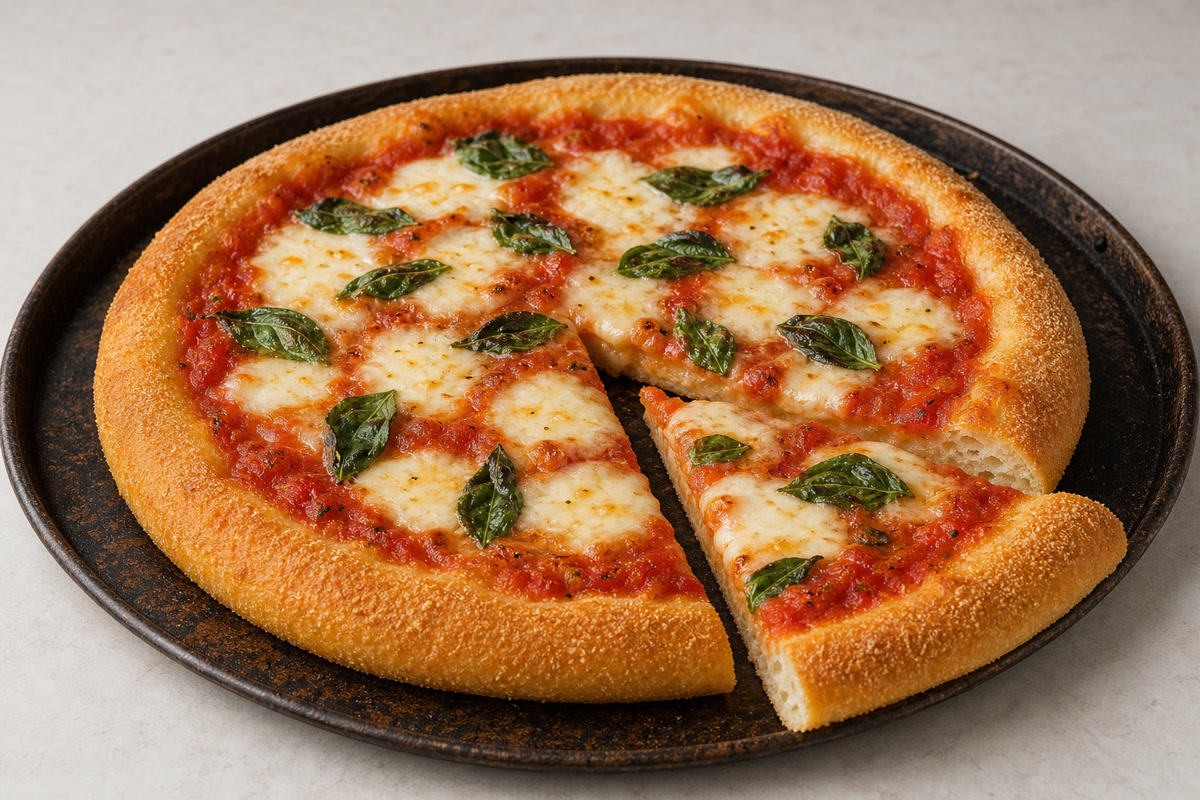
Filipino-American pizza | Pandesal-style crust | Tomato, mozzarella, and basil
A breadcrumb-coated rim gives this tomato, mozzarella, and basil pizza its pandesal connection. Milk powder, butter, and a little sugar enrich the dough without turning it into a sweet roll. Keep the topping light so the thin center can bake beneath the fresh cheese.
About This Recipe
This is a pizza dough with pandesal-inspired details, not a batch of rolls pressed flat. Bread flour supplies the structure for stretching, while the modest enrichment and fine breadcrumbs give the raised edge its particular flavor and texture.
Moisture control matters as much as shaping. Drain and blot the fresh mozzarella, spread the sauce thinly, and leave small gaps between cheese pieces. Parmesan and basil finish the pizza after baking, where the leaves stay fresh against the hot cheese and crisp rim.
Ingredient Notes
Pandesal-style, not sweet-roll dough
Milk powder, sugar, butter, and breadcrumbs give the crust a familiar pandesal aroma and finish. The restrained enrichment keeps the bottom from turning cakey.
Bread flour
Bread flour gives this softly enriched dough enough strength to stretch. All-purpose flour works, but the rim will be a little less chewy.
Fresh mozzarella
Drain it well and blot the pieces dry. Excess whey can pool on a pizza before the crust has time to crisp.
Breadcrumb edge
Use fine, plain dry breadcrumbs, not panko. A light coating on the oiled rim echoes pandesal without creating a heavy breading.
Cooking Notes
- Brush oil only on the raised rim before pressing on the fine breadcrumbs. Keeping the center clear leaves room for a thin, even layer of sauce and mozzarella.
- Use the prepared-peel option unless your parchment is specifically rated for the selected oven temperature. An 'oven-safe' label alone does not establish suitability for this high-heat bake.
Filipino-American Margherita Pizza with Pandesal-Style Crust Recipe
A tomato, fresh mozzarella, and basil pizza on a softly enriched, breadcrumb-edged crust inspired by pandesal and designed for a standard U.S. home oven.
Yield: 1 (13-inch) pizza, cut into 8 slices Serving size: 1 slice (1/8 pizza)
Yield note: The dough weighs about 410 grams and makes one medium-thin 13-inch pizza with a puffy rim. Count on 4 main-dish servings or 8 snack-size slices.
Shopping List
- bread flour
- instant yeast
- nonfat dry milk powder
- granulated sugar
- fine salt
- unsalted butter
- olive oil
- fine plain dry breadcrumbs
- prepared pizza sauce
- fresh mozzarella
- Parmesan cheese
- fresh basil
Ingredients
Pandesal-Style Pizza Dough
- 225 grams (1 3/4 cups plus 2 tablespoons) bread flour
- 148 grams (1/2 cup plus 2 tablespoons) warm water, 105 to 110 F
- 1 tablespoon (8 grams) nonfat dry milk powder
- 2 teaspoons (8 grams) granulated sugar
- 1 teaspoon (3 grams) instant yeast
- 3/4 teaspoon (4 grams) fine salt
- 1 tablespoon (14 grams) unsalted butter, melted and cooled
Breadcrumb Rim
- 1 teaspoon olive oil
- 2 tablespoons (14 grams) fine plain dry breadcrumbs
Margherita Topping
- 1/3 cup (85 grams) prepared pizza sauce
- 6 ounces fresh mozzarella, drained, blotted dry, and torn into 3/4-inch pieces
- 1/2 ounce Parmesan cheese, finely grated (about 3 tablespoons)
- 10 fresh basil leaves
Instructions
- Combine the bread flour, milk powder, sugar, instant yeast, and fine salt in a large bowl or the bowl of a stand mixer.
- Add the warm water and melted butter. Stir until no dry flour remains, then let the shaggy dough rest for 5 minutes so the flour can hydrate.
- Knead by hand for 8 to 10 minutes or with a dough hook on medium-low speed for 6 to 8 minutes. The dough should be smooth, elastic, and slightly tacky but should release from the bowl.
- Shape the dough into a ball, place it in a clean bowl, cover, and let it rise in a warm room until about doubled and visibly airy, 60 to 75 minutes.
- During the final 45 minutes of rising, place a pizza stone or steel on a lower-middle rack and heat the oven to 500 F. For a dark heavy pizza pan or sheet-pan fallback, heat the oven to 475 F and allow 2 to 4 extra minutes of baking.
- Drain and blot the mozzarella again if moisture has collected. Keep the pieces chilled until the crust is shaped so they stay easy to distribute.
- Gently deflate the risen dough and shape it into a 13-inch round, leaving a 3/4-inch rim. If the dough springs back, cover it and wait 10 minutes before continuing.
- Transfer the round to a prepared pizza peel for direct transfer to the stone or steel. Use parchment only if its manufacturer explicitly rates it for 500 F and permits this use; an 'oven-safe' label alone is insufficient. For the 475 F pan method, shape on an unlined nonstick metal pizza pan rated for that temperature, or use parchment explicitly rated for at least 475 F. Brush only the raised rim with the listed olive oil, then press the fine breadcrumbs onto it.
- Spread the pizza sauce in a thin layer inside the rim. Distribute the mozzarella evenly, leaving small open spaces where steam can escape.
- Slide the pizza onto the hot stone or steel and bake until the bottom is browned, the breadcrumb rim is deep golden, and the cheese bubbles in spots, 9 to 12 minutes. On a conventional pizza pan, bake until the same visual cues are reached.
- Move the pizza to a cutting board and immediately scatter on the Parmesan and basil leaves.
- Rest for 3 minutes so the cheese settles, then cut into 8 slices and serve hot.
Nutrition Estimate
Approximate values based on USDA-style generic ingredient data and common package labels. Actual nutrition will vary by brand, exact portion size, ingredient substitutions, and how much flour, oil, or topping remains after preparation.
Tips For The Best Filipino-American Margherita Pizza with Pandesal-Style Crust
- Weigh the flour: A scale keeps the dough soft. Scooped flour can make this small batch stiff enough to resist stretching.
- Preheat the baking surface: Give a stone or steel at least 45 minutes at temperature so the enriched crust sets before the toppings release moisture.
- Keep the center thin: Press gas toward the rim and avoid rolling over the edge. That preserves the puffy breadcrumb-coated border.
- Use sauce lightly: One-third cup is enough for a 13-inch round. More can make the center soft, especially with fresh mozzarella.
- Watch the rim: Milk powder, sugar, butter, and breadcrumbs brown faster than a lean pizza dough, so begin checking at 9 minutes.
How To Serve And Store
Serve hot with a crisp green salad or roasted vegetables; two slices make a practical main-dish serving. Cool leftovers within 2 hours, cover, and refrigerate for up to 3 days. Reheat slices in a dry covered skillet over medium-low heat for 4 to 6 minutes, or in a 375 F oven for 6 to 8 minutes; microwaving softens the breadcrumb rim. To make the dough ahead, cover and refrigerate it after kneading for up to 24 hours, then let it stand at room temperature for 60 to 90 minutes before shaping.
Common Questions
Is this the same dough as pandesal?
No. It uses pandesal-style enrichment and a breadcrumb finish, but it is formulated with more stretch and less sweetness so it behaves like pizza crust.
Can I use active dry yeast?
Yes. Stir the active dry yeast into the warm water with the sugar and wait 5 to 10 minutes until foamy before adding it to the flour.
Can I use low-moisture mozzarella?
Yes. Use 5 to 6 ounces, shredded from a block. The result will be less milky but easier to brown and less likely to release water.
What can replace the milk powder?
Replace the warm water and milk powder with 148 grams of warm whole milk. The crust may brown a little faster, so check it early.
Why did the dough snap back while shaping?
The gluten needs time to relax. Cover the partly shaped round for 10 minutes, then continue stretching without forcing it.
Why does this pizza dough keep shrinking when I stretch it?
Cover the partly shaped round and give it the ten-minute rest specified in the method. Then continue gently, preserving the raised rim instead of forcing the dough outward until the center tears.
How do I keep fresh mozzarella from making the pizza wet?
Drain and blot the torn cheese, checking again if liquid collects while the dough rises. Distribute the pieces with small gaps and keep to the listed sauce amount so the center is not covered by a heavy, wet layer.
Technique and food-safety references: reynoldsbrands.com.