Fresh Strawberry Syrup
 Recipe Guy
Fresh berry syrup | Lemon-bright finish | Refrigerator recipe
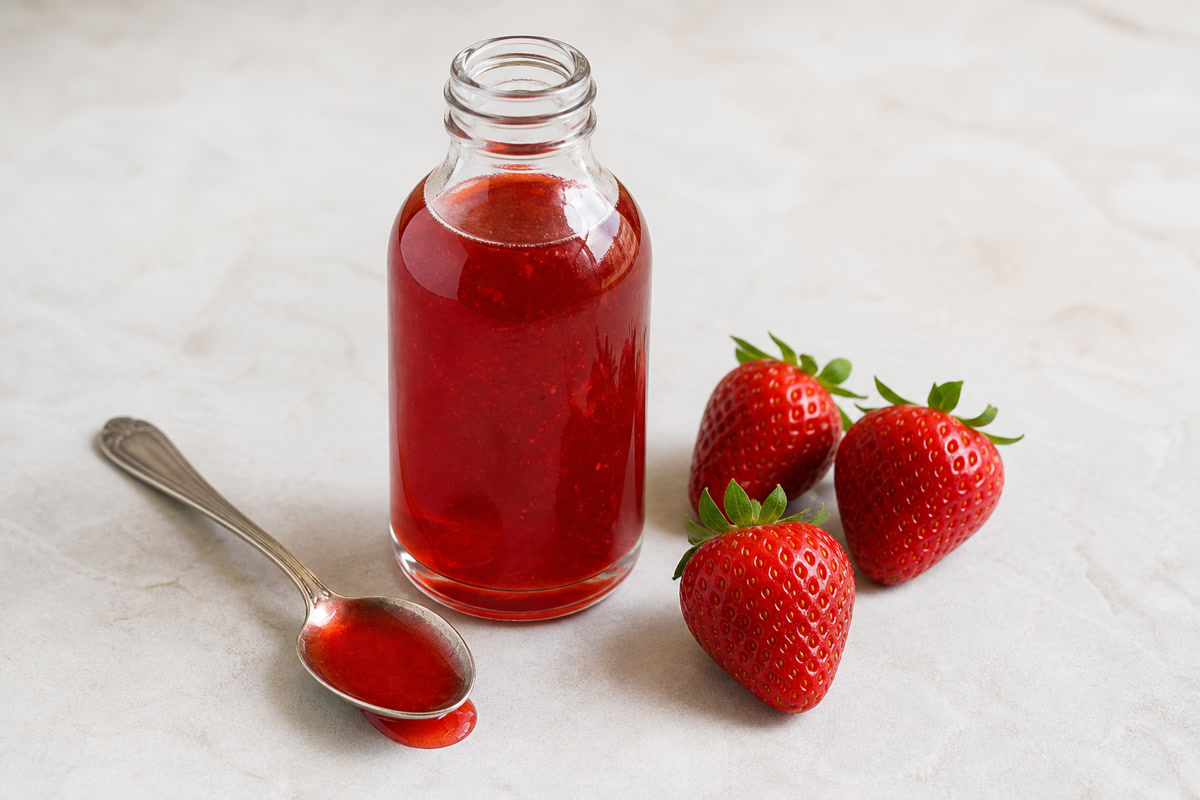
Fresh strawberry syrup begins before the saucepan: sliced berries rest with sugar until their red juice collects in the bowl. A gentle simmer draws out the rest, and lemon added off heat keeps the strained syrup bright enough for drinks as well as pancakes.
About This Recipe
The divided sugar has two jobs. Half sits with the fruit during maceration, while the rest dissolves in water for the cooking liquid. Scrape all the berry juice into the pot; leaving it behind would discard part of the flavor you just drew out.
Straining lets you choose a clearer syrup or a little more body. Give the berries time to drain before pressing lightly, and avoid forcing puree through the mesh. This is a refrigerator syrup, not a pantry preserve, with rapid cooling built into the method.
Ingredient Notes
Strawberries
Use fully red, fragrant berries without mold or leaking spots. Rinse before hulling so water does not collect inside the fruit.
Maceration
Resting the sliced berries with half the sugar draws out juice before heat is applied and keeps the flavor recognizable as fresh strawberry.
Lemon juice
Two tablespoons brighten the berries and balance the sugar. Add it after cooking to preserve its fresher aroma.
Clarity
Minimal pressing gives a clearer syrup. Firm pressing increases yield and body but pushes more pulp through the strainer.
Cooking Notes
- Rinse the strawberries before removing their tops, then drain well. Cut unusually large berries into smaller pieces so they soften alongside the quartered fruit rather than lagging behind.
- Watch the simmer rather than trying to reach the final thickness while the syrup is hot. A hard boil drives off extra water and can concentrate the mixture beyond a pourable syrup.
Fresh Strawberry Syrup Recipe
A vivid fresh strawberry syrup with real berries and lemon, gently simmered and strained for sodas, iced tea, pancakes, shaved ice, and desserts.
Yield: About 1 3/4 cups, or 28 tablespoons Serving size: 1 tablespoon
Yield note: Ripe berries, pan width, and how firmly the fruit is pressed all change the yield. Expect about 1 3/4 cups of full-flavored syrup; a lower yield will be thicker and more concentrated.
Shopping List
Produce
- fresh strawberries
- lemon
Pantry
- granulated sugar
- fine salt
Ingredients
Fresh Fruit
- 1 pound (454 g) fresh strawberries
- 1 cup (200 g) granulated sugar, divided
Syrup and Finish
- 1 cup (240 ml) water
- 2 tablespoons (30 ml) fresh lemon juice
- 1/8 teaspoon fine salt
Instructions
- Rinse the strawberries under cool running water and drain well. Hull only after washing, then quarter the berries; cut very large ones into sixths so the pieces cook evenly.
- Combine the strawberries with 1/2 cup of the sugar in a nonreactive bowl. Toss well and let stand for 20 minutes, stirring once halfway through, until a pool of red juice forms.
- Meanwhile, combine the water, remaining 1/2 cup sugar, and salt in a medium saucepan. Bring to a gentle simmer over medium heat, stirring until the sugar dissolves.
- Scrape the strawberries and every drop of their juice into the saucepan. Return to a simmer, then lower the heat so the berries bubble gently rather than breaking apart in a hard boil.
- Cook for 10 to 12 minutes, stirring two or three times, until the berries look pale and soft and the liquid is bright red. Skim off excess foam with a clean spoon if needed.
- Remove from the heat, stir in the lemon juice, cover, and let the fruit infuse for 10 minutes.
- Set a fine-mesh strainer over a heatproof bowl and pour in the fruit. Let it drain for 10 minutes. Press once or twice with a flexible spatula for a fuller syrup, but do not force puree through the mesh.
- Set the bowl of syrup in a larger bowl of ice water and stir occasionally until it is no longer warm, about 15 minutes. Rapid cooling protects the fresh flavor and shortens its time at room temperature.
- Transfer to a clean container, cover, label with the date, and refrigerate immediately. Save the cooked fruit pulp only if desired and refrigerate it separately for up to 3 days.
Nutrition Estimate
Straining removes an unmeasured share of the fruit fiber and other solids, while reduction changes the number of servings. Actual values vary with berry ripeness, pressing, yield, ingredient labels, and portion size; this is an estimate, not a regulated nutrition label.
Tips For The Best Fresh Strawberry Syrup
- Start with sound fruit: Cooking does not improve moldy or fermented berries. Sort the carton before washing and discard damaged fruit.
- Keep the boil gentle: A hard boil muddies the flavor, breaks seeds loose, and evaporates enough water to push the syrup toward jam.
- Add lemon last: Off-heat lemon tastes brighter than lemon simmered for the full cooking time.
- Choose clarity or body: Let gravity do most of the straining for a clear drink syrup; press lightly for a thicker pancake or dessert syrup.
- Date the bottle: Fresh fruit shortens the storage window, so a visible date is more useful than relying on memory.
How To Serve And Store
Serving: Use 1 to 2 tablespoons in sparkling water, lemonade, iced tea, milk, or a fruit shake. Spoon it over pancakes, waffles, yogurt, ice cream, halo-halo, or shaved ice.
Refrigerate: Keep covered at 40 F or below and use within 4 days. Freeze extra syrup in small portions for longer storage.
Freeze: Freeze in 1- or 2-tablespoon portions for up to 2 months. Thaw only what you need in the refrigerator.
Safety: This fresh-fruit syrup is not shelf-stable and is not a canning formula. Do not rely on its sugar or lemon content for pantry storage. Discard it for mold, fizzing, pressure, or a fermented smell.
Common Questions
Can I use frozen strawberries?
Yes. Thaw 1 pound in the refrigerator, include all the released juice, and begin with the maceration step. The finished syrup may be slightly cloudier.
Can I make the syrup less sweet?
Use 3/4 cup sugar for a tarter, thinner syrup. Refrigerate it and use it within 4 days because the tested yield and concentration will change.
Why did my syrup turn thick like jam?
It boiled too hard or too long, concentrating the sugar and natural pectin. Warm it gently with 1 tablespoon water at a time until it pours.
What can I do with the strained strawberries?
Refrigerate the pulp separately and use it within 3 days in yogurt, oatmeal, smoothies, or as a toast topping. It is not included in the syrup nutrition estimate.
Can I can this strawberry syrup?
No. This small refrigerator batch has not been developed or tested as a canning recipe. Freeze it for longer storage.
Should I press the cooked strawberries firmly through the strainer?
Not for a clear drink syrup. Let the fruit drain first, then press lightly only if you want a little more body and yield. Forcing puree through the mesh changes the texture and makes the syrup cloudier.
Why did I get less than the expected amount of strawberry syrup?
Berry juiciness, pan width, evaporation, and straining pressure all affect the yield. A lower volume can be more concentrated rather than incorrect. Keep the simmer gentle and compare its pouring consistency after cooling, not only its volume.